February 17, 2026
Hiring a Supercar in Dubai: The Complete Guide for Tourists

By Colin Greig
Founder & Editor-in-Chief
Dubai has the cheapest supercar hire rates of any major tourist destination in the world. A Lamborghini Huracán that costs $1,800/day in Los Angeles costs the equivalent of $700–$900/day in Dubai. The Rolls-Royce Ghost that runs $2,500/day in London? AED 4,000–5,500 in Dubai, which is $1,090–$1,500 at current exchange rates. This gap is structural, not a pricing error — and understanding why it exists helps you navigate the market without making the mistakes most tourists make.
What Tourists Get Wrong About Dubai Rentals
The two most common tourist mistakes: assuming any car hire company is legitimate (there are fly-by-night operators), and assuming the cheap daily rate is the full cost.
The cheap rate is real. The hidden additions are also real.
Salik tolls are automatic road toll charges that hit certain Dubai roads and bridges. Sheikh Zayed Road — the main highway spine of the city, where you'll spend most of your time — has Salik gantries. The charge per pass is AED 4 (about $1.10), but if you're doing multiple passes per day it accumulates. Operators handle Salik differently: some include a balance in the car's account and charge overage; some bill you per pass at the end; some add a flat AED 50–100/day Salik fee. Ask specifically.
Radar fines are more consequential. Dubai runs one of the most intensive speed camera systems in the world. Sheikh Zayed Road's posted limit through the city is 100 km/h with an 80 km/h buffer zone near junctions. On the outskirts and arterials, limits vary from 60–120 km/h. Cameras are fixed and unmarked. A fine for 20 km/h over is AED 600 ($163). Rental companies pass these fines to you plus an administrative fee of AED 100–250 per citation. Budget for this explicitly — especially in a car that makes 100 km/h feel like you're barely moving.
Deposits run AED 10,000–20,000 ($2,700–$5,400). This is materially higher than US market deposits. Some operators accept the deposit on a credit card; others want a separate bank transfer or cash deposit. Clarify the deposit structure before committing — being surprised at pickup is how trips start badly.
License & ID Requirements
Dubai accepts foreign driving licenses for tourists on short stays (typically defined as 30 days or less, though check current UAE RTA guidance).
The following licenses are accepted by most operators without additional documentation:
- UK license — accepted directly; IDP not legally required but strongly recommended
- US license — accepted; IDP recommended; some operators require it depending on emirate
- EU license — accepted from all EU member states
- Canadian license — accepted; IDP recommended
- Australian license — accepted; IDP recommended
An International Driving Permit (IDP) costs about $20–$25 from an automobile club in your home country (AAA in the US, AA in the UK, NRMA/RAA in Australia). It's a multilingual translation of your license, not a separate license — but it satisfies UAE RTA requirements and prevents any ambiguity at the rental counter or if you're stopped. Get one before you travel. It takes less than 30 minutes.
Your passport must be valid with a valid UAE entry stamp or visa. Operators will photograph both your license and passport at pickup.
Note for GCC residents vs tourists: Residents with a UAE license have a simpler process but residents from GCC countries other than UAE have their own documentation requirements. This guide covers tourists only.
Where to Drive (And Where Not To)
Sheikh Zayed Road
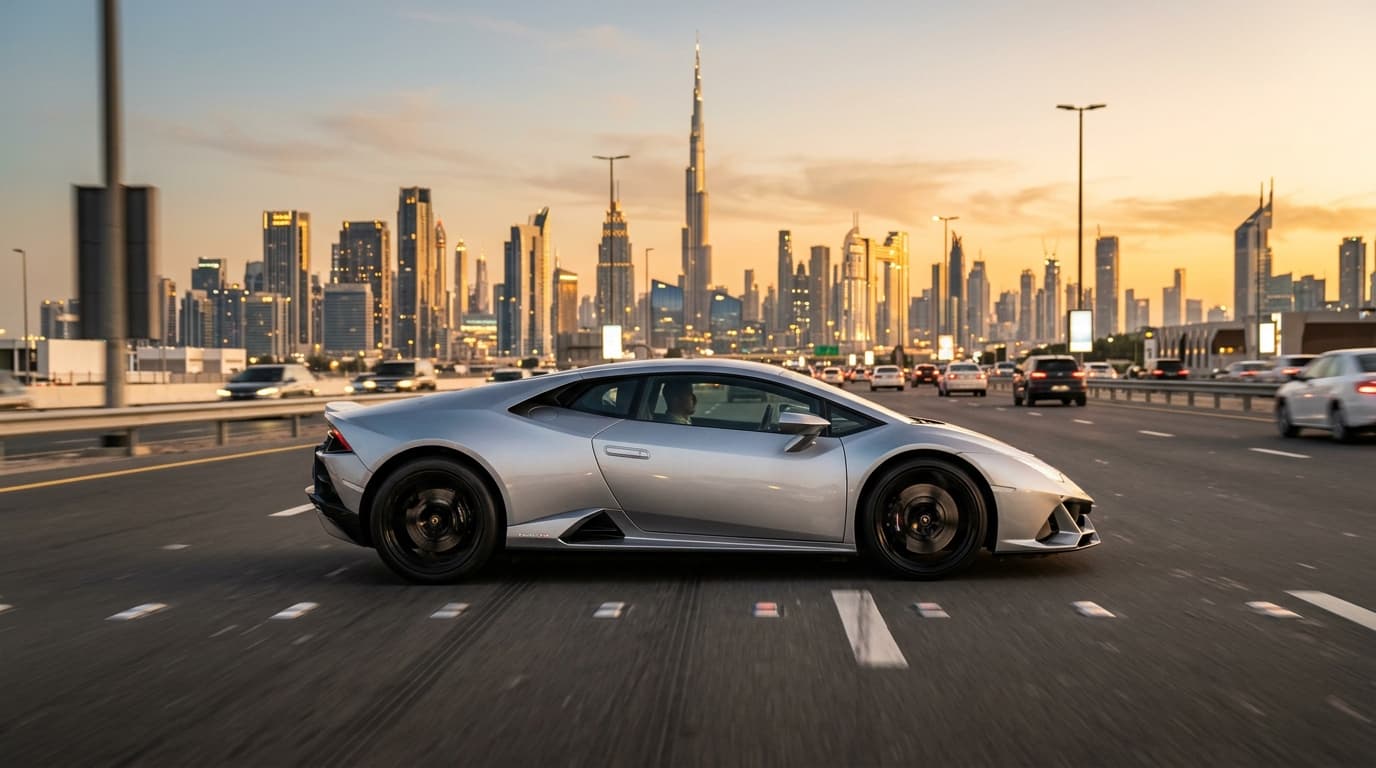
This is Dubai's main artery — 10 lanes wide in sections, lined with skyscrapers, and the road that defines Dubai's visual identity. Driving it in a Ferrari or Lamborghini at night with the Burj Khalifa lit up in the distance is a legitimate bucket list item for enthusiasts. It's also congested during peak hours (8–9:30am, 5–8pm) and camera-dense throughout. Drive it in the evening to avoid traffic.
Jumeirah to Al Qudra Loop
The Al Qudra Road circuit, accessed via the Emirates Road south of the city, is where serious Dubai drivers go. Al Qudra is a wide, well-maintained highway that runs through the desert — minimal traffic on weekends, a few roundabouts, and posted limits of 100–120 km/h on long straight sections. It connects with Hessa Street and cycles back toward Jumeirah. A full loop takes 60–90 minutes and covers genuine, open road.
The Hatta Dam Drive
Hatta is 115km east of Dubai along the E44 highway, passing through the Hajar Mountains. The mountain section from Hatta town toward the dam offers the only real elevation changes near Dubai — actual corners, varying surfaces, and dramatic scenery. Allow 90 minutes each way. This is the best drive available within reasonable distance of the city. The road surface is excellent, speeds are realistic, and the landscape is one of the genuinely striking things about the region.
Where Not To
The Palm Jumeirah loop is Instagram-friendly but practically useless as a drive — it's slow, heavily patrolled, and the frond roads are residential. Jumeirah Beach Road (JBR) on a Friday night is beautiful to look at and awful to drive through. Old Dubai around Deira is narrow, congested, and not built for wide-body exotics.
Salik Tolls & Radar Fines — Budget for This
There are currently 8 Salik toll points in Dubai. Sheikh Zayed Road has multiple. If you're driving SZR daily, budget AED 20–40/day in Salik depending on your route. Al Maktoum Bridge (connecting Bur Dubai and Deira) is tolled; so are several arterials toward the airport.
Speed camera distribution is dense enough that you should treat posted limits as hard limits, not suggestions. The cameras are calibrated tightly — a 20 km/h buffer does not exist in practice the way it does in some Western countries. Some operators add a "fine protection" fee (AED 50–100/day) that covers your first fine. It's usually not worth it unless you're genuinely uncertain about your speed discipline.
Inventory Reality: What's Actually Available
Dubai's supercar hire market has genuine depth. On any given day across the market:
- Lamborghini Huracán and Urus — widely available, multiple generations, often 2023–2025 model years
- Ferrari 488, F8, and Roma — common; Roma has become a popular choice for visitors wanting something less obvious than a Huracán
- Rolls-Royce Ghost, Cullinan, and Wraith — strong availability; Cullinan is disproportionately popular
- Bentley Bentayga and Flying Spur — well-stocked
- McLaren 720S and Artura — available but less common than Lamborghini/Ferrari
- Porsche 911 GT3 and Taycan — available; GT3 in particular draws a waiting list at busy periods
Less common: Bugatti Chiron (exists, $15,000–25,000/day), Koenigsegg (rare, bespoke arrangements only), Pagani (not in standard hire market).
Typical Prices by Model
Midweek base rates from established Dubai operators, in AED and approximate USD:
| Model | AED/day | ~USD/day |
|---|---|---|
| Lamborghini Huracán | 2,500–4,000 | $680–$1,090 |
| Lamborghini Urus | 2,500–4,000 | $680–$1,090 |
| Lamborghini Aventador | 5,000–10,000 | $1,360–$2,720 |
| Ferrari F8 Tributo | 3,000–5,500 | $820–$1,500 |
| Rolls-Royce Ghost | 4,000–6,500 | $1,090–$1,770 |
| Rolls-Royce Cullinan | 4,500–7,500 | $1,225–$2,040 |
| McLaren 720S | 4,000–7,000 | $1,090–$1,905 |
| Bentley Bentayga | 2,800–4,500 | $762–$1,225 |
Weekend surcharges apply Thursday–Saturday (UAE weekend is Friday–Saturday), though most tourist-facing operators now apply Friday–Sunday surcharges for foreign visitors.
Pickup Logistics: Hotel vs Airport
Most established Dubai exotic hire companies offer delivery to hotels in the major tourist zones: Downtown Dubai, JBR, Palm Jumeirah, DIFC. Delivery fees are typically AED 150–300 ($40–$80). This is the right approach for most tourists — pickup at the company's lot in Al Quoz or Al Barsha requires navigating Dubai traffic in an unfamiliar city before you've driven the car.
Airport pickup is available but adds complexity. Dubai International (DXB) drop-off and pickup procedures for exotic hires are informal — the car meets you at a designated zone, not the rental car facility. Clarify the exact meet point before you land.
Summer Low Season: 15–30% Off
Dubai in July and August is hot by any standard — 40–45°C (104–113°F) days with humidity. Tourist numbers drop significantly. Hire companies respond by discounting: 15–30% below the rates listed above is realistic for July–August bookings. If you're based in the region or have a trip that happens to fall in summer, the savings are substantial.
The driving experience in summer requires some planning. Early morning (6–9am) before the heat peaks is bearable with AC running. Midday is not. Night driving — 9pm onwards — is genuinely good: traffic is lighter, the city lights are spectacular, and ambient temperatures drop to the mid-30s.
Browse all Dubai exotic rental companies or explore other international markets to compare options.