April 9, 2026
Vegas Formula 1 Weekend: Exotic Rental Prices Double — Here's Why

By Colin Greig
Founder & Editor-in-Chief
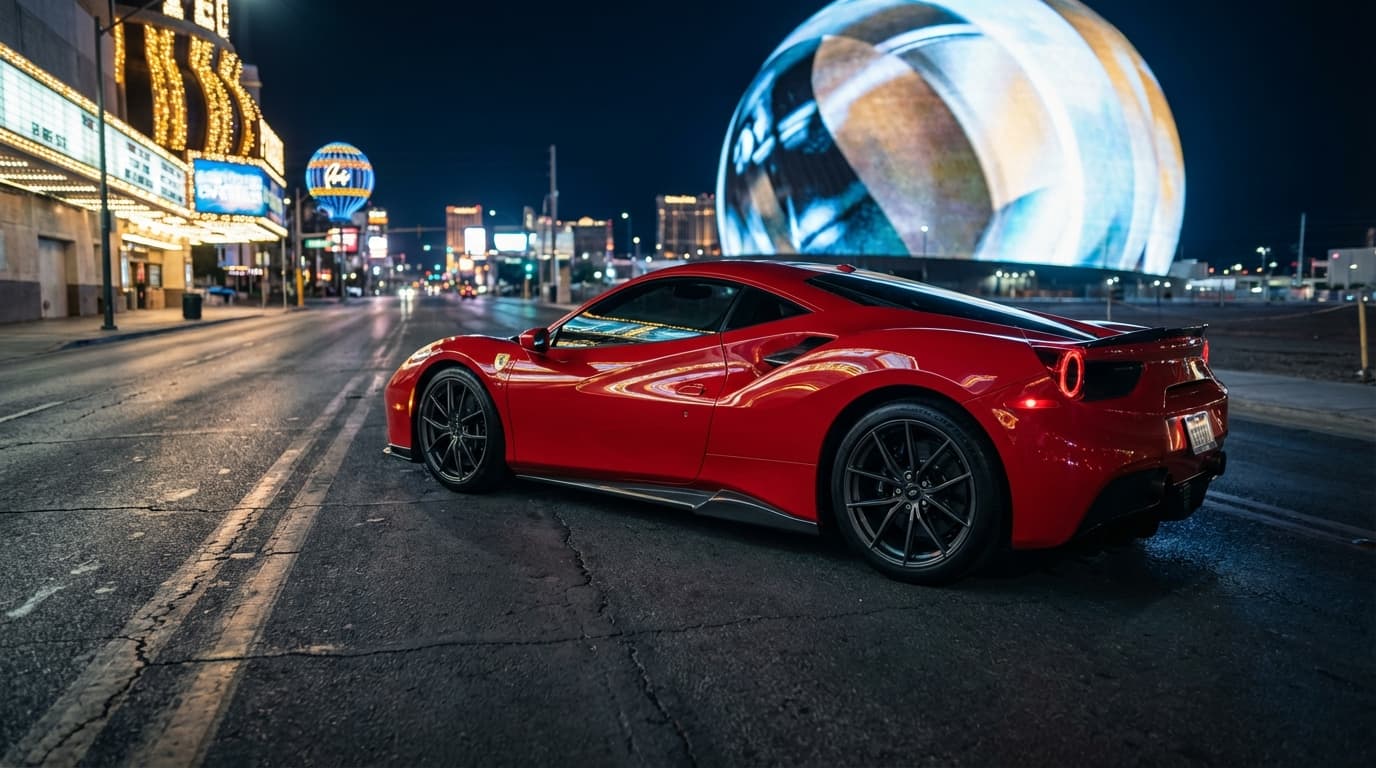
Formula 1 landed in Las Vegas in 2023 and within one racing season had restructured the city's entire exotic rental market for a three-day window every November. The circuit runs directly through the Strip — past the Bellagio, past Caesars, past the MGM Grand. The race doesn't just bring F1 fans to Vegas; it turns the most photographed street in America into a race circuit, and everyone who rents a car during that week wants something worthy of the context.
The result: a pricing spike unlike any other event in the US exotic rental calendar. Operators who charge $1,800–$2,400 for a Huracán on a normal November weekend post $3,500–$4,500 for the same car during F1 week. The inventory sells out anyway.
The 2025 Pricing Spike (What Actually Happened)
The 2025 Las Vegas Grand Prix ran the third weekend of November. By early September — 10 weeks out — every Lamborghini Aventador and McLaren in the city was booked. By mid-October, Huracáns were down to single-digit availability across all operators. The last wave of Huracán bookings at the $4,200–$4,500/day rate filled in the final two weeks.
What made 2025 distinct from 2023 and 2024 was the deposit escalation. Operators who required $3,000–$5,000 deposits in previous years moved to $8,000–$15,000 for F1 week bookings, citing one factor: the 2023 race had multiple incidents of damage claims where renters disputed liability, and the complexity of sorting those during an event week was significant. Higher deposits filtered the booking pool.
A secondary factor: hotel package deals. Several Strip properties offered F1 packages that bundled exotic car rental with the hotel room, nightclub access, and grandstand tickets. These bundle deals tied up fleet inventory before consumer bookings opened, reducing available cars and supporting higher direct rates.
2025 F1 week peak pricing:
| Car | Normal November Rate | F1 Week Rate | Premium |
|---|---|---|---|
| Lamborghini Huracán | $1,800–$2,400 | $3,500–$4,500 | ~90% |
| Lamborghini Urus | $1,400–$2,000 | $2,800–$3,800 | ~90% |
| Ferrari 488/Roma | $1,800–$2,600 | $3,500–$4,800 | ~85% |
| McLaren 720S | $2,000–$3,000 | $4,000–$5,500 | ~85% |
| Rolls-Royce Wraith | $2,000–$3,000 | $3,800–$5,000 | ~75% |
| Lamborghini Aventador | $3,500–$5,000 | $6,500–$9,000 | ~75% |
2026 Outlook: Early Booking Data
For the 2026 race (expected mid-November, official dates TBD), early booking patterns suggest the market is pricing in roughly the same premium as 2025, with one notable shift: minimum rental periods. In 2025, some operators offered single-day bookings during F1 week. For 2026, the dominant approach among established operators is a 2-day minimum, effectively doubling the minimum outlay.
If 2025 was your reference: book 8+ weeks before the race. The most in-demand cars (Aventador, McLaren 720S, Huracan Performante) will sell at or before that window. The Urus and standard Huracán have slightly more inventory depth but still move fast — 6 weeks out is reasonable for those.
Why Prices Double: Inventory Shuffle, Deposit Escalation, Hotel Package Bundles
Three mechanisms work together to drive the F1 premium:
Inventory scarcity. Las Vegas has a relatively large exotic fleet for its size — roughly 25–35 active operators — but that fleet is still finite. F1 typically draws 100,000+ fans to the city over the race weekend, many of whom want transportation that matches the event's profile. The ratio of demand-to-supply compresses sharply.
Hotel package pre-commitment. The Strip's major properties lock in rental cars as part of their F1 packages starting in July. MGM, Caesars, Wynn, and Venetian all run some form of bundled F1 experience. The operators that win these hotel contracts commit inventory 4–5 months out. Consumers booking directly get what's left, which is less inventory at higher prices.
Deposit premium filtering. As deposits rise, the effective cost of booking increases even before you pay the daily rate. A $12,000 deposit tied up on a card for 4 days is real friction. Operators have found that raising deposit requirements reduces customer service burden (lower-budget renters are less likely to book with high deposits), which makes F1 week more operationally manageable.
The minimum day requirement math. If you're an operator managing 10 cars for a 3-day event, a 2-day minimum means 20 total booking days across 10 cars rather than potentially 30 single-day bookings. Operationally, this is dramatically simpler and generates similar revenue.
Which Cars Sell Out First
The order is roughly predictable:
- Lamborghini Aventador / SVJ — gone first, every year. Vegas has fewer of these than Huracáns, and demand for the last V12 naturally aspirated Lamborghini (as of this writing) is intensely sentimental during a motorsport event.
- McLaren 720S / 765LT — close second. The F1 connection is obvious and McLaren operators often market directly to race attendees.
- Ferrari SF90 / 488 Pista — harder to find than base 488s and move quickly.
- Lamborghini Huracán Performante / STO — the performance variant moves faster than the base car.
- Standard Huracán — the volume model. More inventory depth than the above, but still books solid 5–6 weeks out.
- Lamborghini Urus / Ferrari Roma / similar — the last to sell out, often available 3–4 weeks before the race.
The Delivery Logistics Nightmare (Strip Traffic During F1 Week)
The Las Vegas Formula 1 circuit runs directly along the Strip. The race weekend involves significant road closures — parts of Las Vegas Boulevard, Koval Lane, and Sands Avenue are restricted during practice, qualifying, and race sessions. This creates a delivery logistics challenge that operators handle inconsistently.
What this means practically:
Delivery windows are constrained. Operators won't commit to specific delivery times during race sessions. If you want a car delivered Thursday evening during practice, you might wait 2–3 hours beyond the scheduled time. Build buffer into any time-sensitive plan.
Off-Strip delivery is faster. If your hotel is off the main Strip (think Palms, Rio, Hard Rock, or even Henderson), delivery is significantly more predictable. Strip hotels during race weekend face access challenges that off-Strip hotels don't.
Self-pickup is the cleanest option. Some operators are open to this during F1 week — you Uber or taxi to their lot and drive the car away yourself. This eliminates delivery delay entirely and is worth asking about.
Hour-by-hour delivery realities on race day (Sunday):
- Pre-6am: Easy. Almost no restriction.
- 6am–noon: Manageable with navigation knowledge.
- Noon–race start (~10pm): Increasingly difficult. Grid access roads close progressively.
- Race in progress: Strip access for non-event vehicles is effectively impossible in central areas.
- Post-race (midnight+): Grid clears slowly. Expect 60–90 minutes for traffic to normalize.
If you need a car for Sunday night post-race (common for late departures), morning pickup before noon is the reliable approach.
Booking Windows: 8 Weeks Out Is Standard
12 weeks before (August for a mid-November race): Premium inventory — Aventadors, McLarens, limited-edition variants — is available at F1 pricing. This is the window if you have specific car requirements.
8–10 weeks before: Core inventory (Huracán, Urus, Ferraris) is available, pricing is fully set at event-week rates, and deposit terms are confirmed. This is the practical sweet spot for most bookings.
5–7 weeks before: Urus and standard Huracán remain available but inventory is thinning. Some operators may have cancellations, but you're increasingly competing with people who planned ahead.
Less than 4 weeks: What remains is typically either high-end cars (Aventadors or Cullinans held at top-of-market prices) or entry-level inventory (used Huracáns from operators who didn't sell out). The middle is gone.
Should You Drive a Paddock Club Route?
The answer is mostly no, and here's why: the F1 circuit access points that would make driving near the track interesting are closed to road vehicles during the event. What gets photographed is the paddock area (ticket-only) and the pit lane (ticket-only). The public-facing part of the Strip is gridlocked.
What exotic renters actually do during F1 weekend in Vegas:
- Dinner drives to venues like Summerlin, Henderson, or east Las Vegas where there's no congestion
- Desert routes — Red Rock Canyon National Conservation Area is 20 miles from the Strip and accessible even during the race (just avoid heading into town at peak times)
- Content creation at pre-arranged locations with a photographer before race-week crowds arrive (Thursday morning is typically the best window)
- Late-night Strip photography after the Friday practice session when road access briefly normalizes around 1–2am
F1 Weekend vs. CES Week vs. NFR Week Comparison
Las Vegas hosts multiple high-demand events annually. F1 is not the only pricing spike:
| Event | Typical Timing | Exotic Rental Premium | Booking Lead Time Needed |
|---|---|---|---|
| Formula 1 Las Vegas GP | Mid-November | 80–120% | 8+ weeks |
| CES (Consumer Electronics Show) | First week of January | 30–50% | 4–6 weeks |
| National Finals Rodeo (NFR) | First–second week of December | 20–35% | 3–4 weeks |
| New Year's Eve | Dec 31 | 40–60% | 4–6 weeks |
| UFC championship weekends | Variable | 30–50% | 2–4 weeks |
F1 runs the largest premium by a significant margin — roughly double the CES spike. NFR brings a different demographic where exotic car rental isn't as central to the experience, so the premium is real but smaller.
CES deserves a mention: the tech-adjacent crowd arriving in January fills mid-tier to top inventory faster than people expect. If you're in Vegas for CES and want a Huracán, the booking lead time of 4–6 weeks is real.
For Las Vegas exotic rentals during F1 week, the operators with the most consistent inventory are the established players who've been running rentals since before the race came to Vegas. They have the hotel relationships, the delivery infrastructure, and the experience managing demand spikes. First-time operators often underestimate the logistics complexity and that shows in service quality during peak periods. Browse our directory to compare operators and their F1 booking terms.